
Plans
Pro Tips
December 30, 2025
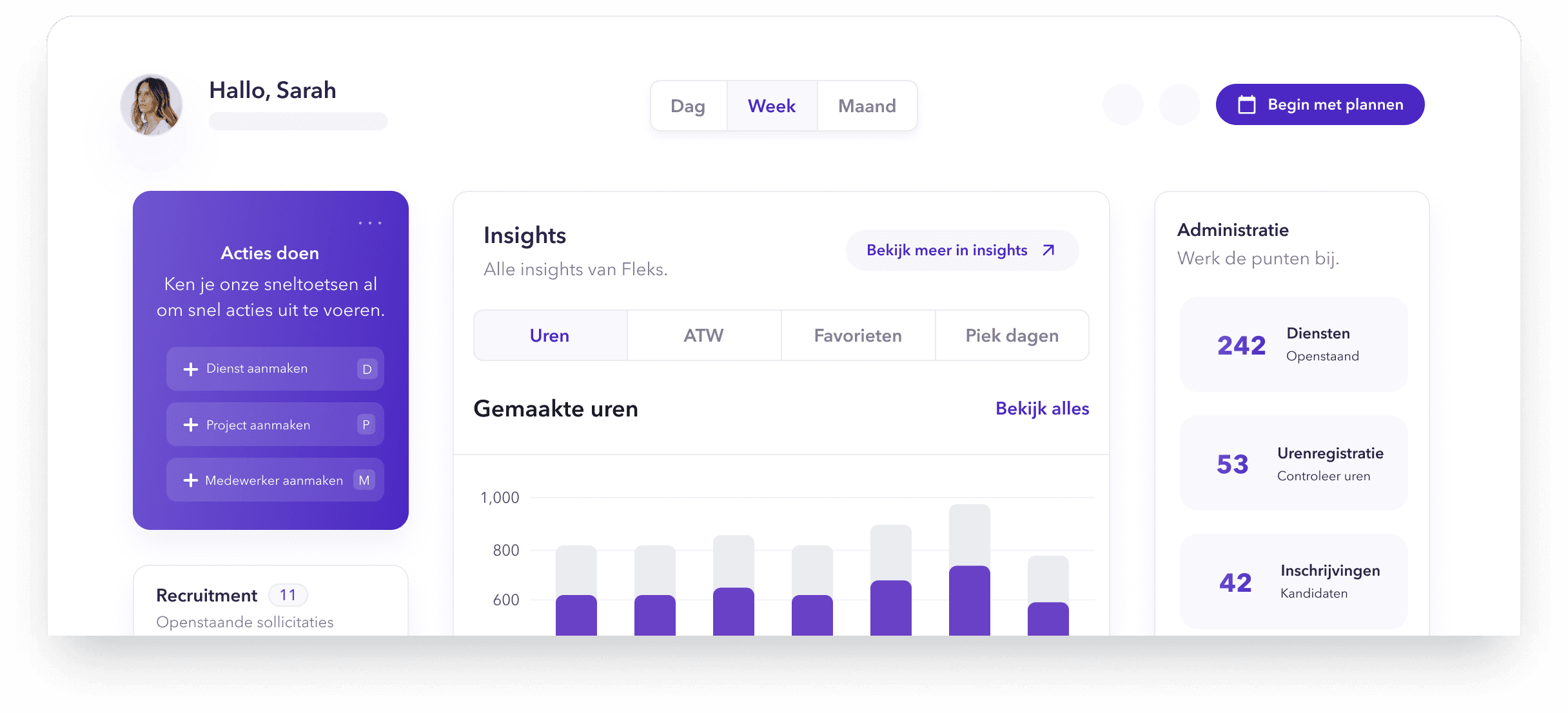
When it comes to personnel planning, many organizations still think of it as simply creating a schedule. But for companies that work on a project basis, operate in multiple locations, and employ a mix of permanent staff, on-call workers, and freelancers, planning is much more than that. It is a daily puzzle that combines availability, legislation and regulations, costs, and uncertainty.
The reality of project-based personnel planning
In project-based environments, demand is constantly changing. Projects start and end, locations change, and the skills required vary from assignment to assignment. At the same time, employees often work on multiple projects in different locations.
This leads to:
No fixed schedules
Many last-minute changes
Continuously shifting personnel
As a result, planners are often busy with ad hoc solutions instead of being able to look ahead.
Multiple locations, different rules
Organizations that operate in multiple locations have to deal with varying contract agreements, allowances, and rest periods. These differences can even apply to individual employees or types of assignments. In practice, we see that:
Rules are not always applied consistently
Errors only become apparent afterwards
The risk of problems increases as the organization grows.
This makes planning not only complicated, but also risky.
The flexible workforce: temporary workers and freelancers
Flexibility is essential for many organizations. On-call workers and freelancers make it possible to respond quickly and cope with peaks in demand. At the same time, they bring with them additional uncertainty.
Common challenges include:
Insufficient or late availability information
Last-minute cancellations
A lot of manual contact via phone calls, text messages, and coordination
In addition, different agreements and rates apply to permanent employees, on-call workers, and self-employed professionals. The choice of who you deploy has a direct impact on costs and margins.
Fixed core versus flexible shell: a strategic consideration
The balance between permanent employees and flexible workers is not purely an operational choice, but a strategic one.
When do you deploy your permanent core workforce? When do you call in flexible workers? What does that mean in terms of costs, continuity, and quality?
Without proper insight, these choices are often made based on gut feeling, even though the impact is considerable.
Pool management: the forgotten link
Many organizations work with a fixed (or relatively fixed) pool of flexible workers. However, there is often a lack of insight into:
Who is the most reliable?
Who is frequently available
Who should be given priority
Whether the work is fairly distributed
The result: dissatisfied flex workers, turnover of good people, and declining predictability.
Why traditional planning software falls short
Many existing solutions have been developed for:
Fixed schedules
One location
One type of employee
In complex environments, this leads to:
A lot of manual work
Workarounds in Excel
Lack of overview
Stress among planners and unrest among employees
What is needed is not a simple schedule, but a system for capacity and pool planning.
From scheduling to capacity control
Modern workforce planning revolves around answering different questions:
Do we have enough people with the right skills?
Who is available when, and under what conditions?
What is the impact of a change?
When do we use flexible workers, and when don't we?
What are the costs of this plan?
Organizations that have this well organized do not plan reactively, but proactively.
Conclusion
Staff planning within project-based organizations with a fixed core and flexible shell is complex—but not impossible.
Gaining control over availability, rules, pools, and costs creates peace of mind, predictability, and room to grow.
Not by planning harder, but by planning smarter.